Rule 5
My Lot and construction
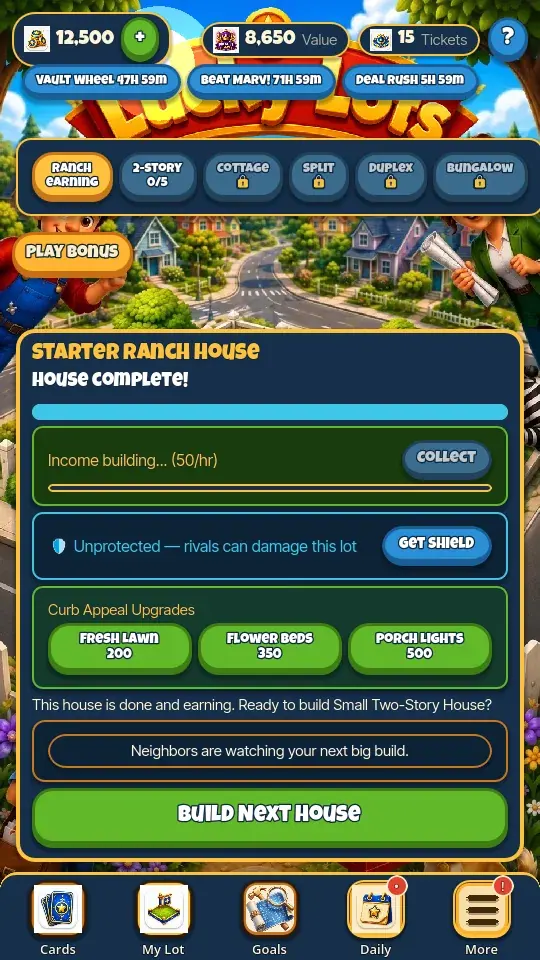
My Lot opens the active unfinished house: first the house already in progress, then another unlocked unfinished or damaged lot. Only one house can be under construction at a time.
- Finish Foundation.
- Finish Walls.
- Finish Windows/Doors.
- Finish Roof/Chimney.
- Finish Final Touches/Landscaping.
- Each stage spends the displayed build cards and Tokens. Foundation opens Pour Day; other stages use their shown construction skill check. A completed stage adds Property Value.
- Card requirements use a gentler bounded curve: no stage asks for more than 18 cards total. Example: with one Meadowgate house complete, the next Foundation needs 8 Foundation cards.
- A house is priced in DEALS, not in a fixed Token number: a finished street costs about 200 card deals a house, and less than that while you are starting out. The Token figure on screen is always the one you pay, and every price in the game shows what it is worth in deals beside it. Event discounts can lower the displayed price.
- Short a build card? You can DEAL for it or BUY it in the Shop. A card costs what dealing for it would have paid, so buying never beats playing — it just skips the wait. This is what a big Token balance is for: Tokens buy build cards, build cards raise houses.
- After Silverleaf Springs come Plumeria Bay, Coyote Mesa, and Seaglass Point. Each destination has six lots and keeps its own tropical, high-desert, or Cape-coast signature house style. These top-tier destinations keep scaling: each costs more to build than the last, matching the rent it pays; later redevelopment laps continue progression.
Rule 6
Rent, repair, and protection
Rent is paid by the NEIGHBORHOOD, not by each house. Finish every lot on a street and it pays 100 Tokens an hour, forever, on top of every street you finished before it. A part-built street pays nothing, so the last house is worth as much as the first five. Rent banks itself and sweeps to your wallet once an hour — there is no Collect button. Damage can reduce a property's usefulness until its listed repair is paid or helped.
Every lot you build is exposed. An unguarded property can be attacked for damage, and an unguarded player can be robbed by a rival's steal or caper — while you are playing and while you are away. A Guard Dog is the only thing that answers theft, and it answers it completely: a dogged neighbourhood has nothing worth stealing. A Shield will not do that job; it stops damage, not thieves.
- Curb Appeal upgrades on a completed house improve its presentation. Finishing a house pays Deal Tickets three ways: the Open House gives 5, the new resident's House Warming Gift gives 5 more once you have hosted that Open House, and the Curb Showcase gives 5 plus Property Value once all three upgrades are bought. All three come back on the same lot on every redevelopment lap.
- Attach a Shield or Guard Dog from the Card Album to any lot. One defense covers EVERY lot in that neighborhood, not only the lot you attached it to. A NEIGHBOURHOOD holds at most 3 Shields at once — that is 3 for the whole street, wherever you attach them — and the Guard Dog keeps his own place beside them, so a full stack of Shields never locks the dog out. Defenses do NOT travel: anything still standing when you graduate stays behind on the street you left, so use them up before you finish a neighborhood.
- A Guard Dog stops theft, and it is the single best-value thing you can own. A caper against a dogged mark fails and the thief goes to jail. A Steal against a dogged mark finds nothing behind ANY of its five doors — the dog does not lower the odds, it removes the loot. A Shield stops attack damage instead. They do different jobs and neither covers the other.
- Each defense carries its own meter, and one attack only ever spends ONE block. A Basic Shield — the wheel wedge, the Shop two-pack and the card — blocks a single attack and is then gone, whatever size that attack was. A Property Shield blocks three attacks before it is used up for good. Stack them and they are spent one at a time, cheapest first, so three Basic Shields cover three attacks. A Guard Dog turns away three raids, then he is hungry and stops guarding until you feed him for 200 Tokens from My Block.
- A hungry dog is still yours; he just is not working. The rail badges FEED DOG until you do, and a hungry dog protects nothing in the meantime. Guard Dogs and Shields come from cards or the Shop.
- Building while your neighborhood has no Guard Dog and no Shield shows a one-time warning. You can still build; the risk is real either way.
- A lot under lien from a Mail Call tax bill keeps its place on the map and its Property Value, but it pays no rent and cannot be built on until the debt is cleared. Only one lot is ever under lien at a time, and a second unpaid bill adds to that debt rather than taking a second lot.
- You cannot start a new neighborhood while a lien is outstanding. Finish the street and the lien notice appears instead of the graduation ceremony — clear the debt and the ceremony is offered again straight away. Card deals are where the Tokens to clear it come from.
- Repair notices, My Lot, and Team repair help point back to damaged property. Finish repairs before continuing construction on that lot.
- Shop success receipts read ‘You purchased X for X amount’ using the real item and displayed cost. Continue Shopping closes the receipt and keeps you in the Shop.